
Planting peanutsIt has been quite some time since my last post. I have been blogging in my field notebook, but I don't have an internet connection out at the reserve. So here are some excerpts from my notebook and photos to give you a sense of what I've been up to lately. It won't be a daily blow by blow, just some of the things that happen.
 My new translator Salema and I
1 October 2007
"The rains started the night before last around midnight with a bang. Big thunder and lightning storm. The rains began at midnight last night and the night before. They finished yesterday before 6am. Today the rains were still going at 8:30am. They stopped by 8:45. It is 9:20 now, but the clouds still look very full of chuva [rain]. So I have a day to do… whatever. After lunch I called Sr. Mathe about a translator. I can’t be waiting around all day. I don’t have time. The more interviews I can do now the more I can accomplish. He has found me someone. So tomorrow I will need to contact Hussaine [current translator - always calling in sick]. I’m not contacting him until I meet the new person. TIA - there is always a chance something will go awry."
 Inside Sr. Abraham's Office
2 October 2007
"While I was speaking with Jorge, Olga, and Mateus, Sr. Victoriano came by and requested that I stop by on my way home. I had a hunch that it had to do with the camera. It did. He was having trouble with using it. He had wanted to take a photo of Abraham (his son) wearing a cobra around his neck. I’m not sure if this was before or after they killed and skinned the snake (spitting cobra) or not. It was the problem of not advancing the film. Not a big deal. I finally got to meet his son who is a Rongan sangoma. He completed his training in South Africa, and… speaks English!!! Of all the individuals in the community to speak English I would never have imagined it to be the sangoma. Abraham invited me into his office. Holy mackeral. The real deal. Simba skins, an elephant legbone, various drums, other animal parts on the walls, bottles, jars, and containers full of unknown liquids and dried plants. There were some red, white and black capulanas hanging up too (colors of danger and magic I was informed when I asked). Then he said I could take all the photos that I wanted. I hope I didn’t come off as too excited, I really thought this sort of thing only happened on National Geographic. Abraham does divinations and from that helps diagnose social and relationship problems – a counselor, Marcia’s gonna love that. Wait til I tell her about the snakes. He also does medicine for the body and of course, rituals. Abraham told me that his family are always curandeiros."
 Butterfly on esteira mat
4 October 2007
"At this point, Salema [translator] and I met up with Sra. Amelia (one of the very first people I interviewed, had a wound on her right ankle). She was holding a tortoise/turtle shell on the end of a stick as she walked along. From a distance I thought it was a big spoon. The turtle shell was about 10-11 inches long – it looked like the same species as Happy, the turtle Leocadia found in Gala. I asked if she had eaten it. Amelia said no and had this look of yuck on her face that was priceless. She found the shell and was taking it to the IUCN camp for sale there. Tourists buy strange things I was told. They are also building a office/museum/center of investigation so maybe it will find a home there. That is the building that Sr. Jeremias was working on."
 Albertina
6 October 2007
"Our first interview was with Stella, wife of Vus who works at IUCN doing construction. It went well, but little Albertina was terrified of me. She started crying when I tried to get close to take a picture for her mom. She is 1 years old and I probably look scary. The older toddlers call me mulungo still, but aren’t so afraid. Hey, I’m realistic. I know that all sorts of stories are told about white people – we eat little African children, we steal them, we are ghosts or evil spirits or the ancestors… It reminds me of the time my Uncle Fred visited. My dad told me he was born in Transylvania and that he was a vampire. Then Uncle Fred showed me his teeth and I didn’t sleep a wink all night. I was 7 or 8 at the time."
I traveled back to Maputo for a week, was a bit under the weather, and generally way too busy to blog here. Entering data is not fun.
 Eating breakfast, Papai sits at the table
17 October 2007
"I had a larium dream last night. They're pretty rare because my dreams are intense for the most part anyway. I slept horribly, had a horrible nightmare where I was pulling my brains, or at least something more solid and stringy, out of my nose. One of those dreams where is was so real I could feel the hot, wet stringy tissue moving around in my nose and hanging down my chin."
Yeah, I probably didn't need to include this, but it was just way too weird. Larium is the malaria drug I'm taking. It comes with a lot of dire warnings about depression, intense dreams, hallucinations, etc. So far, I haven't noticed much of a difference between being on and off Larium and I've been on it for over 10 months now (with a month off in June). That's kind of scary.
 Two year old fallow along a back road.
19 October 2007
"Salema explained that Sr. Tembe is the chief of Madjadjane. This is a hereditary position. He is the grandson of the old chief that was killed in the war. The son of the old chief is in South Africa working. The Induna is composed of all the community elders that are 55-70 years old. At this point they have a lot of knowledge about the region, the community, how things are supposed to work, etc. They are both men and women. Older people are still valued for their knowledge, but they are not necessarily a part of the Induna. From the Induna, people elect secretaries and namzadores (both men and women can act in these positions). The secretários resolve problems within the community and work with the induna to settle disputes. Sr. Joel, Sr. Edesse, Sra. Arminda are current secretários. Basically, they act as justices. Namzadores seem to be a cross between detective and lawyer. They discover information about particular problems in the community and then present the information to the chief, secretários, induna, and other namzadores. Currently, Srs. Jeremias and Lapião are namzadores. Interestingly, both investigators are immigrants to the community."
 Ncathlo - Tabernamontana elegans
24 October 2007
"After the firing discussion, he said that the 2 guards that poached are still working for the reserve. Guards X and Y poached 12 reedbuck. I told him that some people in the community were really angry. They live very close to the reserve boundaries, along the path that elephants migrate to Salamanga, and see the poaching as driving elephants out of the reserve. It makes it worse that guards were doing it because they are supposed to be protecting the people in the community from wildlife. A. looked thoughtful and said he hadn’t thought of that. Then he wrote it down, presumably to talk to the administrator about. The relationship between the community and reserve is not great – the poaching makes it worse."
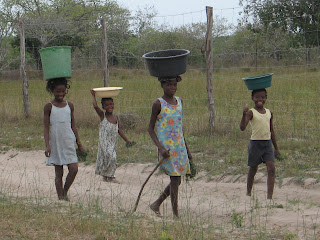 Meninas returning from a macuacua (Strychnos madagascariensis) fruit collecting trip inside the reserve
26 October 2007
So far, everyone has said that resources in Madjadjane are for all residents to use. People may harvest as much as they need – even for production of stuff that is sold to outsiders. Basically, all resources are common pool resources for the community. But this pool is closed to outsiders. Anyone who comes and harvests and is not a resident, or asked for residency and moved in, is considered a thief. The community will catch them (beating them up in the process – Salema was most insistent on this part), take the person to the chief, make the person pay a fine, and then call the police to have them arrested. Those are pretty good deterrents. But how do you identify outsiders then, I asked? I mean, it is obvious for me because I am white, but that isn’t true for everyone. Salema told me that when a relative from outside comes into Madjadjane for a visit or to stay, they first go to Chief Sr. Tembe to make themselves known, explain the circumstances, and ask for permission to stay. Then, the chief will call a community meeting to introduce the person to everyone. That way, if the person is seen walking around in the community people will not be scared of them or suspicious. If the person desires to stay and build a home, the chief will show them places that they could choose for living. Salema said, “you even did this.” People would not talk to you if you didn’t go to Chief Sr. Tembe and then arrange a meeting with the Induna to introduce yourself and why you wish to live and work in the community. Thinking over what Salema said, I’m glad I did meet with traditional leaders. I would really hate to have the shit beat out of me by some suspicious person when I am out harvesting knowledge. And here I was nervous because I thought that it was just about explainig my research project. I didn’t realize that my personal safety was at stake. Salema says that they would not beat me up. But then, what would they do? I asked if an outsider were injured or died how people would respond. He said that they might help, but it would take a while to get a response because the person would not be a known person. Not their responsibility since the person did not introduce themselves to the community. This situation might make ecotourism difficult in Matutuine District. Although given that most tourists are white, staying at the ecotourism lodges, and not harvesting local plants maybe it might work. Also, if they hire a guide then it would definitely work. The upside of all this, is knowing that I am considered part of the community however odd I am."
 Rio Futi - where the hippos live among the cane and papyrus
27 October 2007
"Salema showed up at 7am bright and early. He was wearing bling. Big silver bling, saying 50 Cent. It was a little strange on him. Real gangsta thugs eat nice guys like him for breakfast. I’m ain't sayin' he ain’t got skilz, but his skilz is bush skilz, not street skilz. I’ve noted 50 Cent labeled clothing on a couple other young guys in the community. It stands in stark contrast to their respectful behavior and what their parents and younger siblings wear. Salema’s cousin was collecting sura – not Anton – Cecilia’s son Anmanjidiu. Anmanjidiu and Anton are working together on the sura production. Probably because it would be quite a hike every morning for Anton to the reserve, while Anmanjidiu lives next door. They are cousins so the sharing isn’t quite a difficulty. Anmanjidiu was wearing his “Osama is my hero. Islam is my choice.” T-shirt with a rasta knit touk hiding his crazy Alfalfa hair. He really has a big ‘fro. Anmanjidiu and the rest of his family are Wesleyan Methodist. I only had one cup of coffee this morning – a crappy instant cup of Ricoffe – so the irony was killing me. Salema and I stopped at Lucia’s home on the way to Fernando’s for the charcoal interview. Lucia has malaria. I wished her well, but this apparently was a strange thing to do. So many people get malaria that while it is still considered an illness, it is just something you deal with and get on with your life. Kind of like a head cold. Children still need feeding, laundry washed, machambas planted, etc. So wishing one good health is not seen as appropriate. People do stop by to see if there are things they can help with and to make sure you aren’t flat out in bed running a high fever, but there isn’t much else that can be done."
 Turn off to Madjadjane
29 October 2007
"We passed through the vale that has the 2 big mango trees. I found out that the local name for this place is Incanducene. Every family in Madjadjane has a big space in Incanducene for a machamba. The area is currently fallowed, but next year it will be used again for crops. People have both tempo quente and tempo fresco machambas here. Milho, amendoim, manioca, muitas hortas, cana doce, banana, ananas, all will grow in this place. The name, Incanducene, comes from the fact that cana de açucar grows in this place according to Salema. Every family has a space along the Futi and in Incanducene."
Yes, this is a huge entry. Sorry about that. I hoped you liked the little slices from my October though.


